
If 2025 proved Out-of-Home could move at the speed of culture, 2026 is the year it starts moving at the speed of marketing outcomes.
Canadian advertisers are stepping into a definitional shift: OOH is no longer the final stop for awareness. With Digital Out-of-Home (DOOH) expanding, programmatic access rising, and measurement finally catching up, the channel is evolving into something more powerful, a real-world layer that can be targeted, optimized, and attributed alongside digital.
This article is informed by Vistar Media’s new breakdown of the creative forces shaping 2026 advertising and a recent conversation with Scott Mitchell, Managing Director at Vistar Media Canada. For the full global creative trend framework, you can read Vistar’s report here.
“2026 is the year OOH fully steps into the modern marketing ecosystem,” Mitchell says. “We’re seeing three forces converge at once: digital saturation, rapid DOOH growth, and major advancements in measurement.”
That convergence is reshaping both what brands create and how they buy. And it’s happening right as Canadians return to shared spaces in a big way: transit, retail, stadium districts, concerts, festivals, and the everyday city pulse. For marketers facing screen fatigue and rising digital inefficiency, the street is becoming a high-attention, high-trust place to win back reach.
Why 2026 Will Be a Defining Year for Canadian OOH
Canada’s DOOH market is already scaling fast: IAB Canada reports DOOH revenue reached about $153 million in 2024, up 6.7% year-over-year, as programmatic and data-driven buying mature across the country.
The result is a channel that looks increasingly like digital in how it targets and measures, but remains uniquely physical in how it captures attention. With stronger attribution, smarter creative tools, and deeper integration with retail media and digital strategy, OOH in 2026 isn’t just a media buy, it’s becoming a strategic performance layer for Canadian marketers.
What 2025 Told Us: OOH Isn’t Just “Seen”, It’s Shared
Mitchell points to 2025 as a preview of the channel’s next chapter, where DOOH didn’t sit beside culture, it participated in it.
Justin Bieber’s album launch used synchronized DOOH across Toronto, Vancouver, and Montreal, creating a moment fans carried straight to social.
The NHL playoffs (with three Canadian teams in contention) sparked localized DOOH plays around arenas and fan zones, letting brands tap national pride without paying in-stadium rates.
Retail and experiential OOH sped up: quick-turn competitive creative like The Brick’s response to IKEA and Sleep Country, plus DOOH placements around major live venues such as Downsview Park concerts.
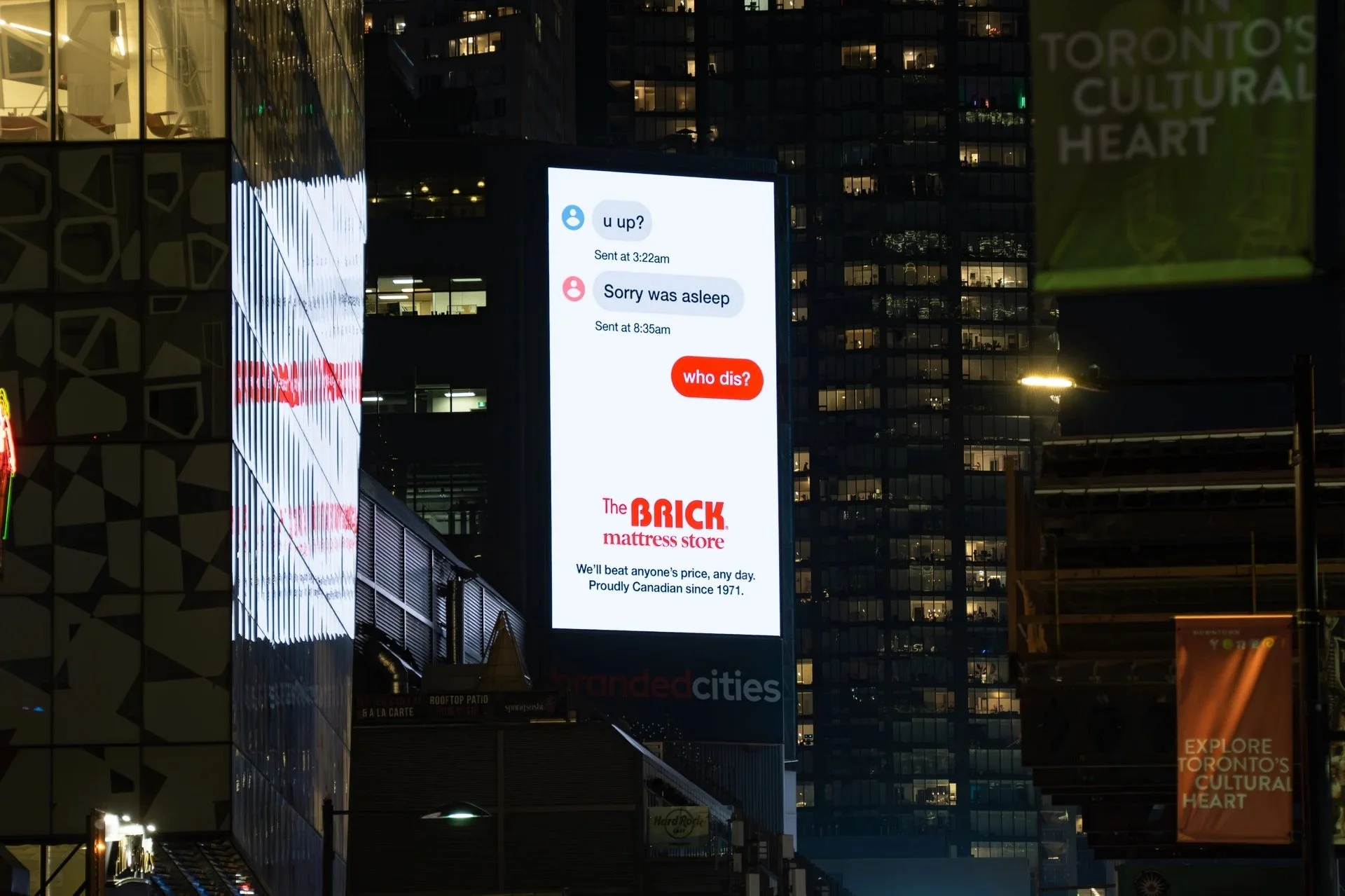
The pattern is clear: when OOH is fast, contextual, and culturally tuned, it doesn’t just amplify moments, it becomes part of them.
The Five Creative Shifts Showing Up in Canadian OOH for 2026
Vistar Media’s latest 2026 creative trends report outlines five major shifts redefining how brands show up across channels. Below is a Canadian OOH lens on those themes, with proof points from 2025 and what they mean for DOOH in the year ahead.
1. Real Humanity Wins in Real Places
As AI-generated content floods feeds, audiences are craving work that feels grounded and human. Purpose-led messaging is sticking when it’s backed by real behaviour, not surface-level posturing.
OOH is built for this era: you’re showing up in someone’s physical life, so authenticity matters more. In 2026, expect Canadian brands to lean harder into community-rooted storytelling, local nuance, and emotion-forward creative that earns attention, not demands it.
2. Context Is the New Targeting
DOOH is shifting creative from static to situational, adapting messaging based on time of day, location, retail proximity, traffic flow, weather, or live events.
Mitchell notes that this doesn’t require “big brand budgets” anymore. Modular creative templates and automated buying mean mid-sized Canadian teams can run campaigns that feel tailor-made for the moment, even if the team behind them is lean.
(If you want the broader cross-channel view — beyond OOH — Vistar’s full creative trends piece is worth the read.)
3. Motion-First Creative Is Becoming Table Stakes
Short-form video and motion branding are now the dominant visual language everywhere, and OOH is no exception.
But the key shift for 2026 is designing for movement from the start. Great DOOH isn’t a print ad on a screen. It’s paced, animated, and built to land in 3–5 seconds, the new currency of attention in public spaces.
4. AI Is Accelerating OOH Creative Scale
AI is moving from helper to collaborator, speeding up ideation and enabling creative versions at scale.
For Canadian OOH, that means a single campaign can generate dozens of variants across regions, languages, and contexts, without multiplying timelines or budgets. The creative advantage in 2026 will come from human insight + AI execution, not either alone.
5. “Set It and Forget It” Is Over
The largest mindset shift: OOH campaigns are becoming living systems. With programmatic DOOH, brands can optimize in-flight, refresh creative based on performance, and chase ROI in real time.
This brings OOH into the same rhythm as social and search, quick feedback loops, smarter reallocations, constant learning.
How Canadian Marketers Can Actually Use OOH in 2026 (Even on Mid-Sized Budgets)
For teams without a massive agency bench, the playbook is getting simpler, and more doable.
“The biggest opportunity is to think of OOH as an extension of the channels you already use, not a separate silo,” Mitchell says.
Here’s what that looks like:
Use OOH to open the funnel, digital to close it: Pair DOOH with retargeting on social/search or retail media to create a full loop.
Start with a context-first idea: Don’t lead with placement. Lead with where your audience is most attentive, commuting, shopping, entering events, gathering in fan zones.
Go modular: Build creative as flexible blocks that can update fast. Canada’s cultural calendar moves quickly, your OOH should too.
Plan for tentpole moments, then stay agile: With Canada hosting 13 FIFA World Cup 2026 matches in Toronto and Vancouver from June 11 to July 19, 2026, brands that plan early, then pivot fast in-market, will be best positioned to win attention around fan zones, transit corridors, and retail hubs.
The Takeaway
OOH in Canada isn’t returning, it’s transforming.
In 2026, it becomes:
more human in tone,
more contextual in delivery,
more motion-led in design,
more AI-powered in production, and
more performance-driven in measurement
The result is a channel that’s finally behaving like what modern marketers need: high-attention reach in the real world, with digital-speed flexibility and accountability.
Editor’s note: This Canadian OOH outlook builds on insights from Scott Mitchell (Vistar Media Canada) and Vistar Media’s 2026 creative trends report. If you’re looking for the full trend framework and global examples across channels, you can read the original Vistar Media article here.
