
Is Shoppable TV Finally Scaling in Canada? Bell Media Thinks So
For years, shoppable TV in Canada has felt more like a conference talking point than something truly operational. The idea made sense. The execution rarely felt built to last.
Bell Media now seems confident that that phase is over.
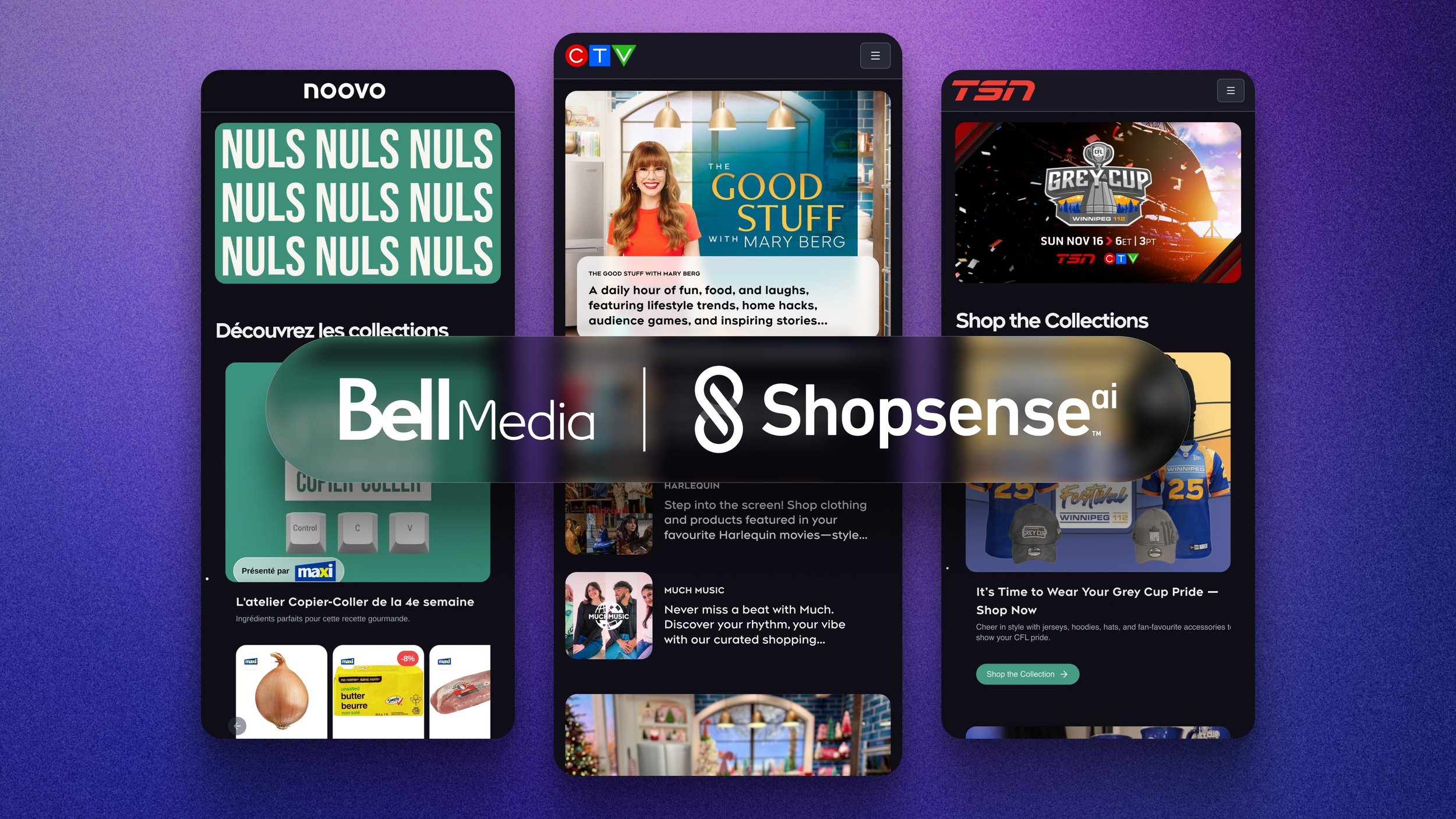
The company has expanded its content-to-commerce partnership with Shopsense AI after a year of activations that turned some of Canada’s most recognizable programming into interactive shopping environments. With the addition of Quebec, this is no longer a contained test. It is a national play.
The real question is not whether shoppable TV exists. It does. The question is whether audiences will treat it as habit rather than novelty.
From Experiment to Execution
Over the past year, Bell Media integrated shoppable experiences across programming including Heated Rivalry, The Good Stuff with Mary Berg, The Social, The Amazing Race Canada, The White Lotus, the Canadian Country Music Awards, The Oscars, and TSN properties such as SportsCentre and the CFL.
This was not positioned as a flashy innovation moment. Bell focused on repetition. In-show integrations. On-screen prompts. Social reinforcement. Small nudges that pointed viewers toward digital storefronts connected to what they were already watching.
According to the company, audiences spent more than 12,000 hours exploring Bell Media storefronts in 2025, generating hundreds of thousands of product detail page views.
Those numbers matter. But the bigger shift is behavioural. Rather than betting on one tentpole event, Bell appears to have treated this as something that needed to be built over time.
That changes the conversation. Shoppable TV starts to look less like a feature and more like infrastructure.
Rethinking What TV Performance Looks Like
Traditional television advertising has always been measured in 15 and 30 second increments. Shoppable integrations complicate that math.
Spin Master’s Cyber Five activation on The Social reportedly delivered more than two minutes of incremental living room engagement among viewers who entered the storefront. Revlon’s Elizabeth Arden integration on The Good Stuff with Mary Berg included premium merchandising and a host endorsement, contributing to a reported 339 percent increase in sales.
Those are not traditional broadcast outcomes. They start to resemble retail media performance layered into premium video environments.
If viewers are browsing, considering, and even purchasing within the same ecosystem where they are being entertained, engagement time begins to matter differently. So does interaction depth. So does downstream sales impact.
That may require agencies and broadcasters to rethink how they define value in connected TV.
A National Play That Changes the Planning Equation
The expansion into Quebec may be the most consequential part of this announcement.
Programming such as Nuls en Chef, Occupation Double, and sports content on RDS will now support shoppable experiences. Bell Media says this makes it the only Canadian media company offering scaled shoppable television across both English and French markets.
For national advertisers, that simplifies things.
Bilingual activations in Canada have often meant fragmented planning and duplicated effort. A unified content-to-commerce approach across Quebec and the rest of the country opens the door to more cohesive storytelling and measurement.
In a media market as concentrated as Canada’s, that kind of scale can move quickly.
What This Means for Canadian Marketers
For brands and agencies, this reflects three meaningful shifts.
1. Commerce is moving upstream into premium content.
Shoppable experiences are no longer confined to influencer posts or social feeds. They are showing up inside broadcast-scale programming, embedded directly into environments audiences already trust.
2. Engagement time is becoming part of the performance story.
When viewers spend minutes, not seconds, interacting with branded storefronts, the measurement conversation changes. Reach still matters. But interaction depth and downstream behaviour start carrying more weight.
3. National scale is getting simpler.
With bilingual shoppable capabilities, marketers can begin to unify English and French activations under a more cohesive content-to-commerce strategy. In a market like Canada, that operational simplicity matters.
Canada’s media landscape is smaller and more consolidated than many global markets. That creates a unique dynamic. When one of the country’s largest broadcasters operationalizes a new model, adoption can accelerate quickly.
Shoppable TV in Canada appears to be entering a different phase. Not experimental. Not theoretical. Built to scale.
If shopping inside premium programming becomes normal behaviour, the living room stops being just a branding environment.
It becomes a commerce one.
