
Canadians split their TV time between linear and streaming, and ads follow them across both. For an advertiser buying the two separately, that creates a problem that rarely shows up in a report. The same household can see the same spot on more than one screen, and the brand pays for it each time.
Samsung Ads Canada calls this the “duplication tax." It isn't a small one. In a U.S. analysis of 18 campaigns across six categories, Samsung Ads found duplication between linear TV and ad-supported streaming averaged 41% of the total audience reached.
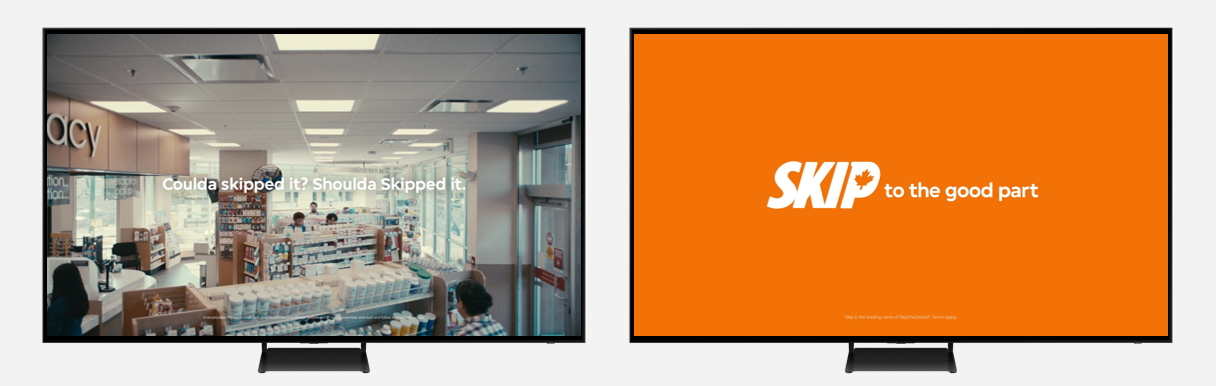
In March 2026, Skip ran a test to see how much of that overlap it could win back. Using Samsung's Optimal Reach, the delivery app reached more than 200,000 Canadian households its campaign hadn't reached before.
The problem with buying linear and streaming separately
Measuring reach across the two hasn't been easy, according to Erin McGrath, Head of Customer Engagement at Skip. “Audiences move between platforms, and the same household can be reached multiple times across different environments," she said. “Without a unified view of that overlap, it can be difficult to understand how much truly incremental reach a campaign is delivering versus how often we are reaching households that have already seen our ads."
The goal, she said, was to get linear and streaming working together to reach more unique households, instead of simply adding more impressions.
How Skip ran the test
Three setups ran at the same time inside Skip's own campaign, each with identical media weights: an unmanaged run-of-network control, a legacy linear suppression setup and Optimal Reach. Because all three ran side by side, the results can be compared directly.
Optimal Reach delivered an 18% unique reach lift, compared with 7% for legacy targeting, according to Samsung. Duplication fell 25% compared with the control, and cost per unique reach dropped 43%.
What Optimal Reach can and can't see
The tool runs on automatic content recognition data from more than 7 million opted-in Samsung Smart TVs in Canada, according to Samsung. Once a household has seen the ad, it drops out of future delivery, and those impressions shift to households that haven't seen it yet.
There are limits, and Dave Pauk, Samsung Ads Canada's country manager, is upfront about them. “There isn't a product in the market today that can control for exposure across every device and platform," he said. What Samsung can do, he added, is look at overlap across Samsung TV, linear and AVOD in one place. “So we're not claiming to see everything … no one can."
How to run your own duplication test
Here's how to set one up with any CTV partner:
Set up a control. Run an unmanaged buy at the same time as the approach you're testing, with the same media weight, so the comparison holds.
Test more than one approach if you can. Ask your partner what options it offers for reducing duplication. Skip compared legacy suppression with Samsung Ads' Optimal Reach, and running both against the same control showed how much each one added on its own.
Judge results on unique reach. Ask for unique reach lift and duplication measured against your control, rather than impressions delivered.
Track cost per unique reach. It shows whether your budget is buying new households or paying for the same ones twice.
Know where the measurement stops. Every platform has blind spots outside its own ecosystem, so ask what your partner can't see before you read the results.
Questions to ask your CTV partner
For McGrath, it starts with one question. “Am I reaching new households, or am I just reaching the same people more often?" she said.
Pauk suggests putting three more to any CTV partner: “How much incremental reach are you delivering? How are you measuring duplication across linear and streaming? And what are you doing to actively reduce that overlap?" Then, he said, “Most importantly, ask them to show you the evidence."
From the vendor side, he sees the bigger lesson as how the channels fit together. The conversation “shouldn't be about choosing linear or streaming," Pauk said. “It should be about understanding how they work together and whether your investment is actually helping you reach more unique households, not just more often."
On the brand side, the test reinforced the case for planning TV as one connected buy. “TV planning should be about more than where ads run or how many impressions they generate," McGrath said. “It should be about understanding who we reach, where we find incremental audiences and how effectively we use our investment to build reach."
