

Written by Cam Gordon
We need to talk about hashtags.
They first hit social media en masse in 2007, popularized by Chris Messina and others as a way to catalogue conversations. Twitter made them dynamic in 2009, opening up infinite portals into potential zeitgeist moments for brands and everyday users.
Now, close to 20 years later, hashtags are still semi-useful. However, they also feel like a vestige of a digital age that doesn’t exist anymore.
In many instances, using a hashtag could be counterproductive for marketers or anyone else vying to be heard within the attention economy. Even Instagram boss Adam Mosseri says hashtags “don’t work,” telling the Daily Mail that users are kidding themselves if they think hashtags will be a shortcut to virality on the new weird internet.
Instagram quietly removed the ability to follow hashtags in 2024 and added a five-hashtag limit to posts in 2025. Both updates are proof that behavioural norms were changing and also proof that hashtags are often just kind of annoying.
Plenty has changed since hashtags went mainstream towards the end of the dumb phone era. Discovery geared toward iOS and Android environments became paramount in the 2010s. The debut of ChatGPT in 2022 was another watershed moment for how, where and why information gets surfaced online.
Hashtags endured through these massive shifts, and yet given the outsized impact LLMs now have on discoverability, community managers and marketers should be very thoughtful in how they use hashtags in their communications.
As an example, I asked Gemini how it might differentiate between Kensington Market and #KensingtonMarket in response to a prompt. Here is what it said.
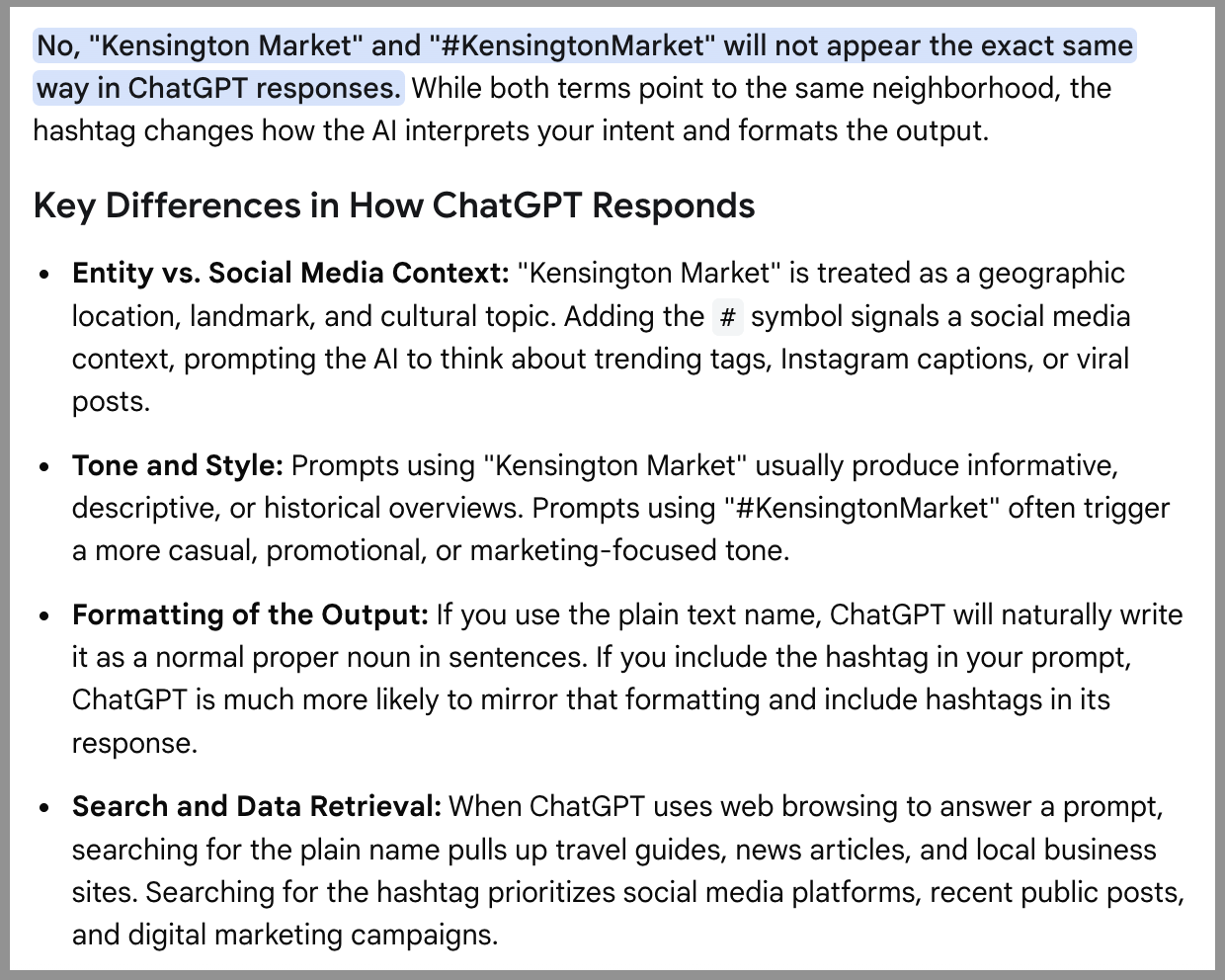
Clearly, AI can be extremely judgy (by design). This means your content could send the wrong signals because of the hashtag(s) you proactively decided to use.
This adds new mechanical considerations for hashtag usage. As important for marketers, there are also matters of perception that didn’t exist five, ten or 20 years ago.
Those new Instagram measures mentioned earlier were seen as tools to mitigate spam and lazy clout chasing. I’m probably not the only one who side-eyes when they see a brand or person on social use excessive hashtags in a present-day post. Rightly or wrongly, cramming your social content with hashtags will make your brand look a little thirsty on the low end and totally spammy on the high end.
It’s also giving your audiences way too many invitations to click away from your content and go read something that’s maybe slightly less lame. In short, you want your brand voice to feel of the moment, and “talking” in many, many hashtags will probably just make you seem out of touch.
Hashtags can still be useful for emphasis, humour or tapping into niche conversations. However, as a content driver, they clearly aren’t as mass market as they once were. This isn't to suggest we're going to start calling them a “pound sign" on social any time soon, but the reality is hashtags have lost some of their utility and cultural currency. They still have their place, but perhaps the smartest move in today's attention economy is knowing when not to use them.
About the writer:
Cam Gordon is a Toronto-based writer and communications professional. He is currently the Director of Communications and Public Affairs for Seneca Polytechnic and was formerly the Head of Communications for Twitter in Canada. Cam has written about music and culture for several outlets including the Toronto Star, Chart Magazine, The Spill, This Magazine and Wavelength Music.
