
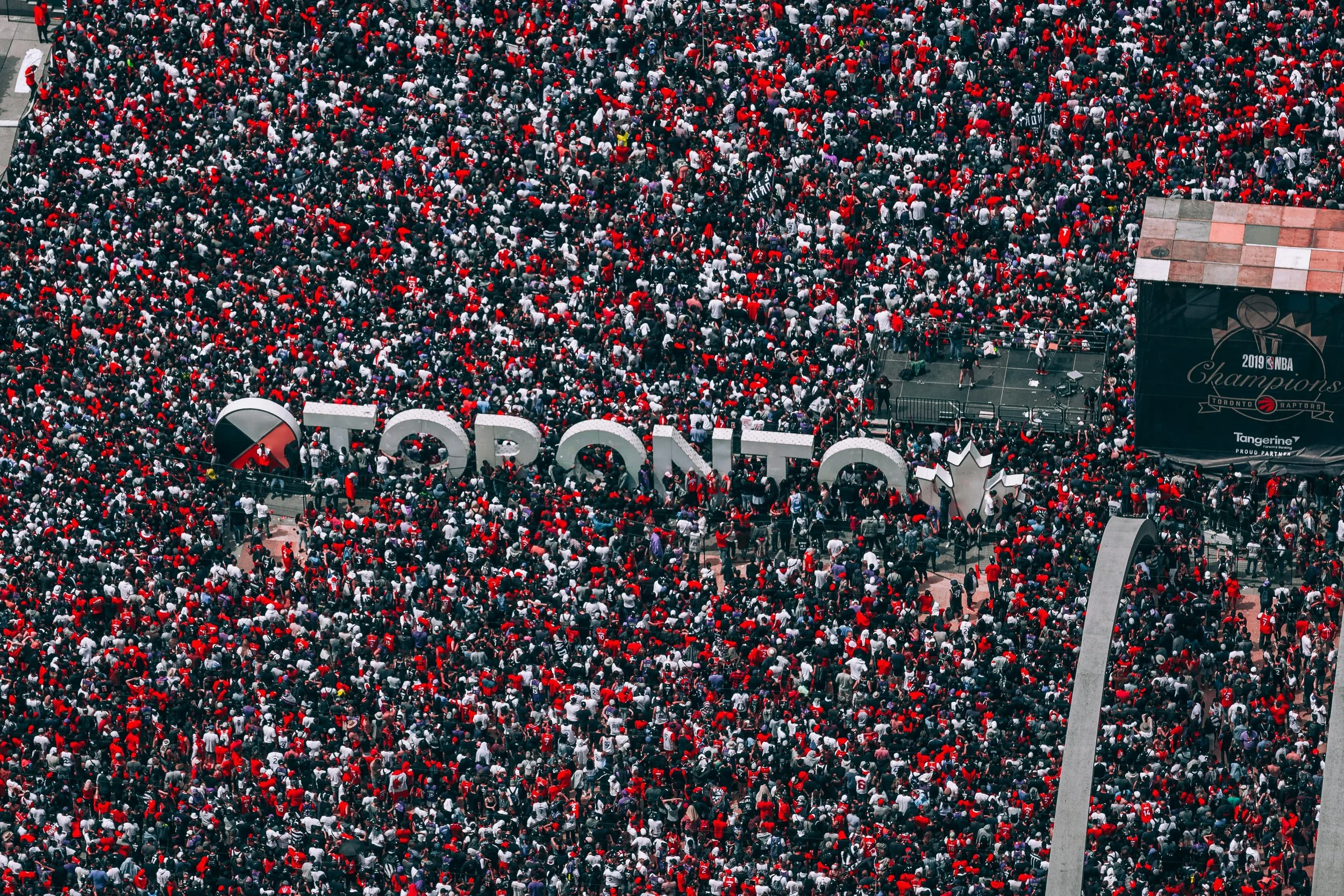
Somewhere between FIFA selling out its last global sponsorship slot for the first time in World Cup history and a tourism board putting an inflatable T-rex on a CFL field in Edmonton, Canadian sports marketing quietly became the most interesting space in the industry.
But the numbers only tell part of the story. The deeper reason every brand wants a piece of sports right now is something that can't be manufactured anywhere else: the person sitting next to you in the stands could have absolutely nothing in common with you. Different city, different background, different everything. And for those two hours, none of it matters. You're in it together. You're both on your feet for the same reason. That shared emotional present tense, that involuntary community, is what brands are really trying to buy when they sign a sports partnership. It's the last thing a fragmented, algorithm-sorted media landscape can't replicate.
And in Canada right now, that window is wide open.
The Numbers Make the Case
Start with the macro signal. Rogers and the NHL recently locked in a 12-year, $11 billion Canadian broadcasting deal, kicking off this season at roughly 2.5 times the value of the previous agreement. The reason? Viewership grew 50 per cent over the prior decade. The value of live sports content, as Rogers CEO Tony Staffieri put it, “just continues to appreciate."
Then there's FIFA. With Canada hosting 13 matches across Toronto and Vancouver this summer as part of the most expansive World Cup in history (48 teams, 104 games), the commercial appetite has been staggering. FIFA confirmed in March that all 16 global sponsorship positions were filled before the tournament even began. A first in World Cup history. Tier-2 sponsors at that level are investing between $65 million and $95 million USD for the privilege.
Those numbers aren't just impressive. They're instructive. They tell you why every brand, from multinationals to regional tourism bodies to Indigenous-owned cleaning product startups, is looking at sports and seeing an opportunity.
The Brands Arriving From Unexpected Places
The most revealing partnerships in Canadian sports right now aren't necessarily the biggest. They're the ones that show how wide the aperture has become, and how differently brands are thinking about what a sports partnership is actually for.
adidas threads the needle from grassroots to pro.
This April, adidas Canada announced a multi-year partnership with Tim Hortons to become the official jersey provider for the Timbits Soccer program, outfitting boys and girls aged three to seven across Canada. The program reaches more than 250,000 youth every season. adidas athlete and Canadian soccer star Jonathan David will front the accompanying TV campaign. This is a brand with $23.7 billion in annual sales choosing to show up at community fields in small towns on Saturday mornings, alongside Canada's most recognized quick-service brand. The message isn't “buy our shoes." It's “we believe in the game from the ground up."
adidas paired that grassroots move with something at the opposite end of the spectrum. Just days earlier, the brand announced a multi-year partnership with the Toronto Blue Jays as their official apparel partner, arriving at a particularly meaningful moment. The 2026 season is the Blue Jays' 50th, a year of Joe Carter statues and Hall of Excellence unveilings and the kind of national nostalgia that money can't manufacture. adidas' “You Got This" platform, built around the idea that every athlete needs someone who believes in them, lands differently against a franchise celebrating half a century of Canadian baseball than it would in any other year. The partnership also extends into youth baseball through the Canadian Futures Showcase for high school prospects. Grassroots to professional, in one campaign cycle.
Think Turkey takes the court.
Turkey Farmers of Canada, operating under the Think Turkey brand, recently launched a partnership with Toronto Raptors forward AJ Lawson, with a “You Turkey" campaign that debuted during the US college basketball championships. Lawson joins a roster of Canadian athlete ambassadors that already includes Olympic gold medalist Damian Warner, soccer player Vanessa Gilles, and hockey player Emmy Fecteau. An agricultural marketing organization threading together multiple leagues and sports to position turkey as everyday fuel for active Canadians. You don't need to be in the sports business to make a compelling sports play. You need a relevant message and the confidence to show up.
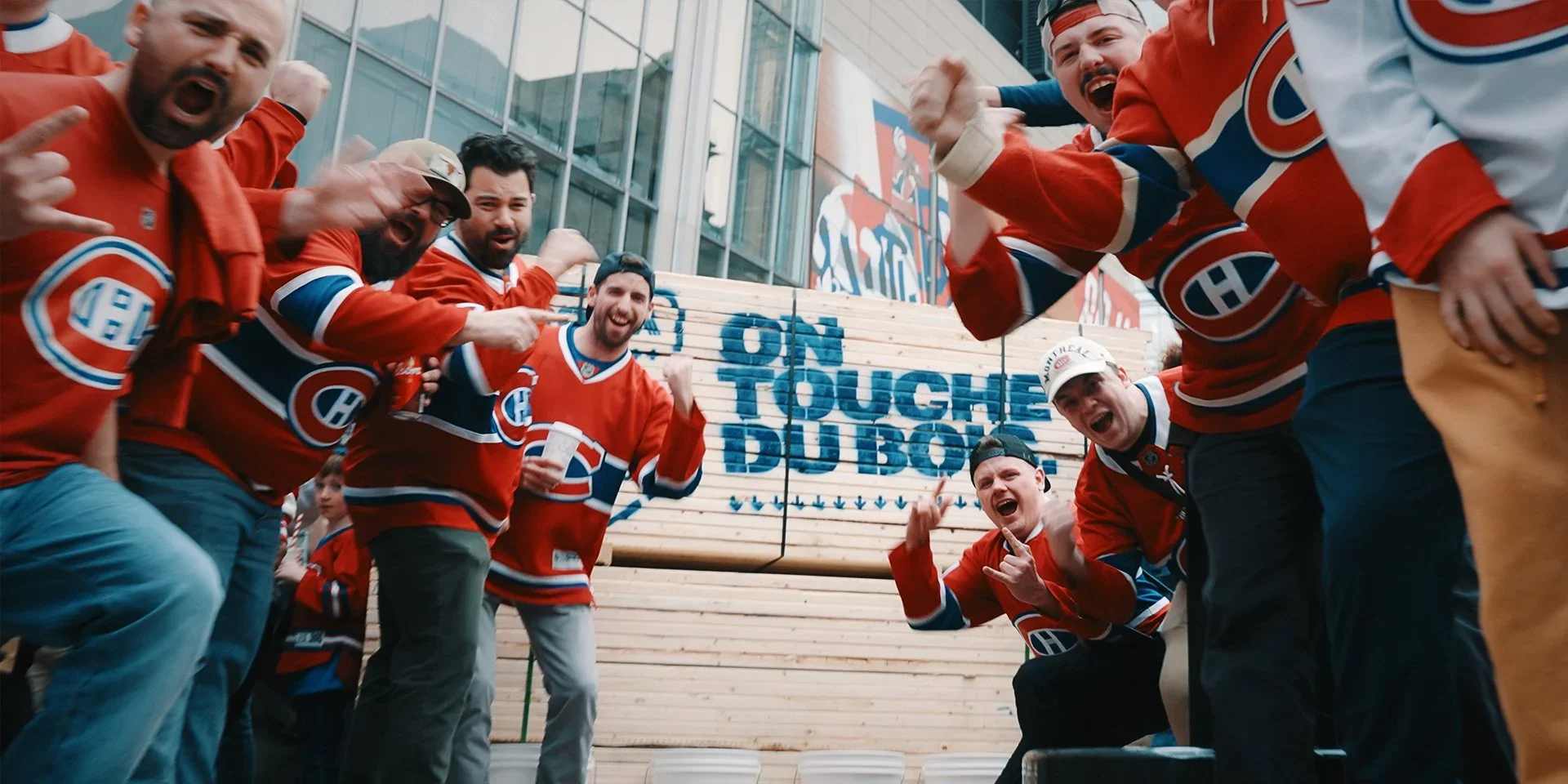
Photo courtesy of SidLee
RONA knocks on wood.
Last NHL playoff season, RONA, the home improvement retailer and sponsor of both the Montreal Canadiens and the Edmonton Oilers, launched one of the most on-brand activation campaigns in recent Canadian sports marketing memory. The campaign, developed by Sid Lee, was called Knock on Wood: a national invitation for hockey fans to channel their playoff superstitions into a literal act. Two towering wooden pallet installations went up at Place des Canadiens outside the Bell Centre and at Fan Park near Rogers Place, becoming interactive pre-game destinations. Fans at the first two home games in both cities received wooden keychains etched with “Knock on Wood" as lucky charms. Rink boards, premium TV spots, and a surprise in-arena appearance from RONA's everyman mascot Mike rounded out the campaign. “At RONA, wood is part of our DNA," said Catherine Laporte, SVP Marketing & Customer Experience. “We want every fan to be able to actually knock on it." That's the whole playbook in one sentence: find the cultural moment that belongs to your brand's category, and own it completely. A pile of 2x4s outside the Bell Centre during playoffs isn't a stretch for a home improvement retailer. It's the most RONA thing imaginable.
CF Chinook Centre takes basketball off the court.
In October 2025, CF Chinook Centre in Calgary partnered with the Calgary Surge of the Canadian Elite Basketball League for “The One," a full-day 1-on-1 basketball tournament held inside the mall in October 2025, complete with a live DJ, interactive activations, and prizes including a $250 CF Shop Card. And they're not stopping there. And this year on June 27, the Calgary Surge Dunk Contest powered by CF Chinook Centre brings four of the city's best dunkers to Zara Court, with Free2Play youth basketball programming running the following day. It's now a recurring partnership with its own programming calendar, not a one-off activation. “With ‘The One,' we're creating an experiential activation that drives engagement, foot traffic, and community connection," said Jason Ribeiro, Vice-Chairman & President of the Calgary Surge. For a shopping centre trying to turn square footage into community space, and for a basketball league trying to build a fanbase in a hockey market, the partnership keeps solving both problems at once. Sports brought to where people already are, not the other way around.
Travel Drumheller brings the dinosaurs.
In the summer of 2024, the Edmonton Elks hosted Dino Day, a game-day takeover presented by Travel Drumheller, the tourism board for Alberta's dinosaur capital. Dinosaur activities filled the Elks Fan Park. At halftime: the world's first inflatable T-rex combine, with the winner taking home a dinosaur-inspired weekend in Drumheller. More than 18,000 fans were in the stands at Commonwealth Stadium. Travel Drumheller is a tourism marketing body with no sports DNA whatsoever. But it understood something important: the Elks' game-day crowd was exactly the audience it needed to move: Alberta families with disposable time and a car. The partnership didn't ask fans to think about tourism. It dropped Drumheller into their Saturday afternoon and let 18,000 people do the work. That's the geographic displacement play: you don't show up where your audience already is. You show up where they are and make them think about where you are.
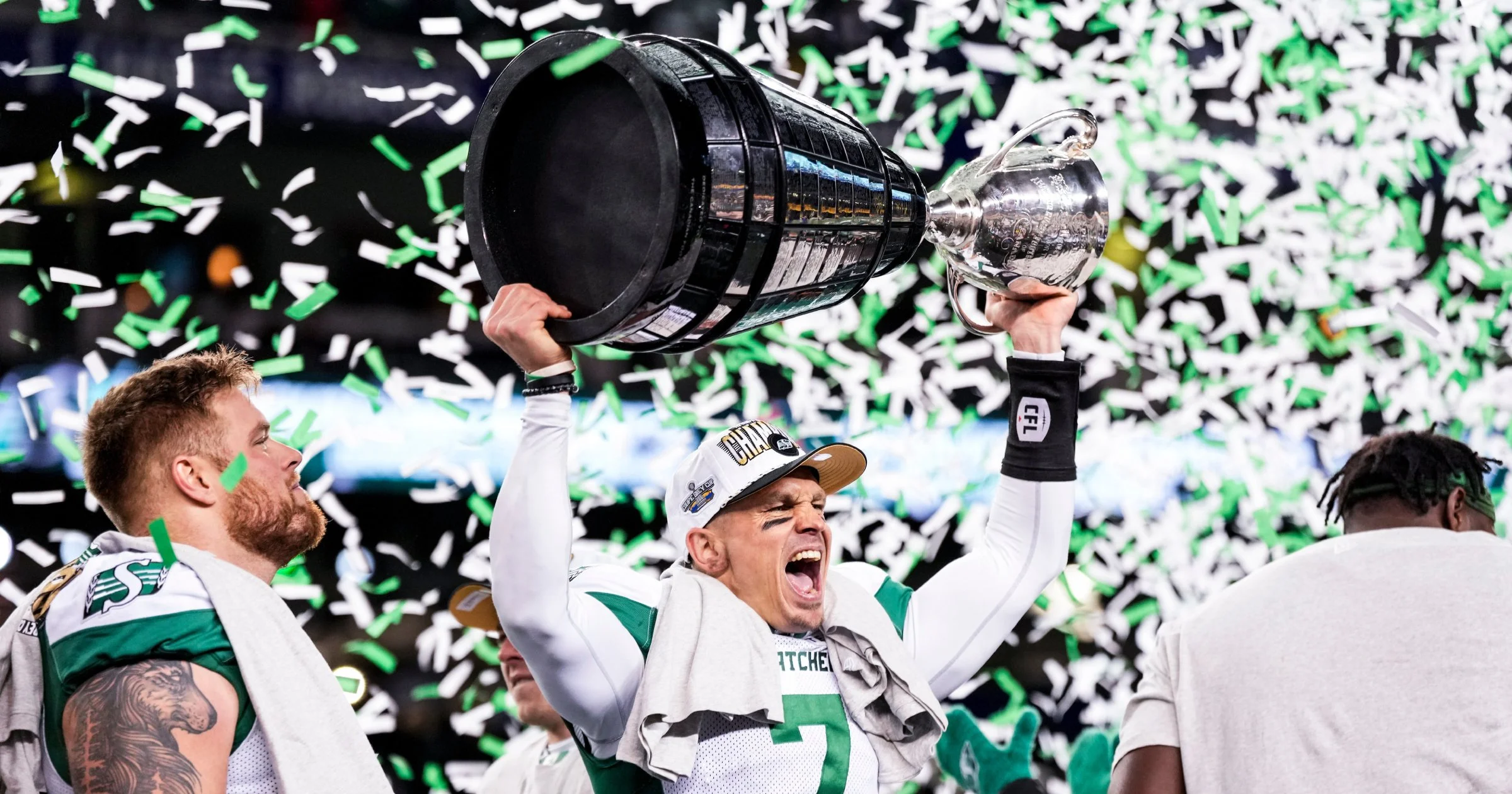
Photo courtesy of the CFL.com
The Small Market Lesson
If there's one team in Canada that proves market size is the wrong lens for evaluating sports partnerships, it's the Saskatchewan Roughriders.
The Roughriders play in the second-smallest major-league market in North America, smaller than Green Bay, Wisconsin. They are publicly owned, non-profit, and have been playing football continuously since 1910. They won their fifth Grey Cup in 2025. And they are, by most measures, one of the most powerful sports brands in the country, third in Canadian sports merchandise sales behind only the Montreal Canadiens and the Toronto Maple Leafs.
What does a partnership with the Roughriders actually mean? Consider the Grey Cup community tour that followed their 2025 championship. The trophy made stops in 36 communities across the province: Humboldt, Nipawin, La Loche, James Smith Cree Nation, Foam Lake, Chaplin, and dozens more. When the club's president said “this Grey Cup belongs to Saskatchewan," he wasn't speaking metaphorically. Rider Nation extends into towns of a few hundred people where the Roughriders may be the only professional sports connection that matters. For any brand that sponsors the Roughriders, that provincial reach is part of what they're buying.
That context makes the Roughriders' partnership with nîkihk a majority Indigenous-owned cleaning products company, a joint venture between a Saskatoon manufacturer and the Battlefords Agency Tribal Chiefs one of the most compelling local brand stories in Canadian sports right now. nîkihk started during COVID, distributing cleaning kits to First Nations communities in Saskatchewan. It has since grown into a retail presence at Sobeys, Safeway, and IGA. As the presenting partner for Riderland the Roughriders' family game day nîkihk products appeared in Mosaic Stadium and on the Rider Store website. “This partnership is about more than business," said nîkihk CEO Bob Behari. “It's about creating value together, rooted in local leadership and shared purpose."
The Roughriders have also built what may be the most thoughtful Indigenous partnership model in Canadian sport. Their Indigenous logo designed by Chris Chipak of Red Pheasant Cree Nation sold out merchandise so completely the club president said “we literally couldn't keep it on the shelf." Proceeds were directed back to Indigenous students across the province, with $60,000 committed in 2026. Merchandise as community reinvestment. That's a partnership model worth studying.
Women's Sports: The Smartest Buy in Canadian Partnerships Right Now
If there's a single shift in Canadian sports marketing that every brand should be paying attention to, this is it.
In two years, Canada has gone from having no professional women's sports properties to having the PWHL, the Northern Super League, the Toronto Tempo joining the WNBA this May, and a growing portfolio of emerging leagues. Combined revenue in Canada's major professional women's sports is expected to reach between $380 and $400 million this year up from $150 to $200 million in 2023. By 2030, that figure is projected to reach $570 million.
The sponsorship data is striking: brands partnering with women's sports can expect up to a 25 per cent increase in awareness, opinion, and purchase consideration among fans, with 61 per cent of Canadians saying those partnerships carry a positive sentiment impact. These aren't vanity metrics. They're outperforming men's sports equivalents on the numbers that matter to a CMO.
Canadian Tire understood this early. The retailer pledged in 2023 to direct half its sponsorship spend to women's professional sports by 2026, becoming a founding partner of both the PWHL and the Northern Super League with multi-year, multi-million dollar commitments. Not charity. ROI.
The boldest structural play came from DoorDash Canada, which launched “BRING IT IN" a campaign uniting the WNBA, NSL, and PWHL under a single sponsorship umbrella. Rather than three separate deals, DoorDash built an alliance of leagues and recruited a national network of independent restaurants to broadcast women's games and run game-day promotions. “Sports sponsorships have historically been fragmented: pitting team against team, league against league," said Heather Cameron, head of brand and creative at DoorDash Canada. “We're rewriting that playbook."
For smaller brands watching from the sidelines, both models are worth studying. Canadian Tire shows you can make a boardroom-level bet on women's sport and have it pay off. DoorDash shows you can build something structurally new, a sponsorship that spans leagues rather than teams and use it to turn independent local restaurants into game-day destinations. Neither required being a traditional sports brand. Both required being willing to move early.
From the Harbour: What Halifax Gets Right
And on Canada’s Atlantic coast, the HFX Wanderers are doing something quietly remarkable.
The Wanderers play Canadian Premier League soccer at Wanderers Grounds, a 7,000-seat stadium in the heart of Halifax built, in part, from repurposed shipping containers. They consistently top the CPL in attendance. Local businesses fly their colours on match day. Their official Pub Partners program brings over a dozen Halifax pubs, restaurants and taprooms into the fold as official match-day venues, giving small hospitality businesses a direct commercial hook into the team's schedule that requires no big-brand budget to participate in. It's a partnership model designed for the scale of the city it lives in.
Their 2026 jersey, made in a new partnership with hummel, tells you everything about who the Wanderers are. The kit honours the Wanderers Amateur Athletic Club, founded in 1882, the historic organization whose name and home ground the club inherited. The design draws from uniforms worn by the original Wanderers, with the Nova Scotia flag's saltire and rampant lion embossed throughout. The alternate kit features Halifax's Citadel fortification and a nod to the shipping containers that built the stadium itself. “This jersey represents the continuation of a 144-year-old promise to make the community stronger through the power of sport," the club said at the reveal.
That's not marketing language. That's what happens when a sports organization understands its community deeply enough that every partnership decision, from the jersey manufacturer to the pub down the street, becomes an expression of that identity.
The Community Weighs In
We didn't have to look far to prove the thesis. When we asked the MNC community on LinkedIn what sports partnerships and activations were catching their eye, the response was immediate and passionate. Turns out, once you really see sports marketing, you can't unsee it.
From Blue Jays fans lining up four hours before first pitch for a hockey-themed jersey giveaway, to a Saskatchewan Roughriders activation called Kid Captain bringing families onto the field, to shoutouts for the Vancouver Canadians, Calgary Wild FC, and the Saskatoon Berries Baseball Club. The examples kept coming. One commenter put it best: “A lot of these activations feel closer to culture than advertising. That's what makes it powerful."
The passion in that thread isn't just heartwarming. It's data. Sports partnerships work because fans are already emotionally invested. Marketers just have to show up with something worth caring about.
The Playbook for Brands Not Yet in the Game
So what does this all mean if you're a brand looking at sports partnerships and wondering where you fit?
You don't need to be sports adjacent.
Travel Drumheller sells weekend getaways. nîkihk makes cleaning products. Think Turkey is a poultry marketing body. None of them had an obvious path into sports. All of them found one by asking a more useful question: where is our audience already paying attention?
Think about where you want people's attention to go, not just where they already are.
The Travel Drumheller play wasn't about reaching Drumheller's existing audience. It was about moving an Edmonton crowd's attention toward Drumheller for one Saturday afternoon. That geographic and psychological displacement, showing up somewhere unexpected to make people think about somewhere else, is an underused idea in Canadian sports marketing.
Small leagues and unexpected venues offer the best access.
The HFX Wanderers' pub program, the Roughriders' family game days, the Calgary Surge inside CF Chinook Centre. These are entry points that don't require a seven-figure commitment. They offer something rarer than reach: genuine community presence. A Wanderers pub partnership means your establishment becomes part of match-day culture in Halifax. A Surge activation in a Calgary mall means your brand is in the room when the community shows up to play. That's not a media buy. That's belonging.
Women's sports are underpriced for what they deliver.
The data is unambiguous. Brands entering women's sports sponsorships right now are getting in ahead of the curve on audience size, loyalty, and commercial returns. Canadian Tire saw this in 2023. The brands that see it in 2026 still have a window, but it's closing faster than most people think.
Think beyond the logo, but also think about the moment.
The best partnerships in this piece aren't about brand exposure. They're about what happens when a brand's category and a team's cultural moment genuinely intersect. RONA and hockey superstition. nîkihk and Rider Nation. Travel Drumheller and 18,000 Alberta families on a Saturday afternoon. The Wanderers and 144 years of Halifax community identity. The logo is the outcome. The insight is the product.
FIFA is coming, and you don't need official rights to activate.
With 13 World Cup matches hitting Toronto and Vancouver this summer, the commercial energy in both cities will be enormous. Brands without official FIFA sponsorships can still activate smartly and legally, through fan zone adjacency, football-themed content, influencer partnerships, and community storytelling that celebrates local pride rather than attempting to borrow FIFA's IP. The audience will be there regardless of what's on your contract.
Sports, it turns out, was never just for sports brands. It was always for anyone who needed to reach people at their most emotionally present. In Canada in 2026, with a Grey Cup champion on a 36-community provincial victory tour, a women's sports market doubling in two years, a Blue Jays franchise celebrating 50 seasons, and the World Cup coming to our backyard, the brands that understand that are the ones showing up everywhere on your feed.
The question isn't whether your brand belongs in sport. It's which community you're ready to be part of.
Have a sports partnership story worth featuring? We would love to hear about it! Reach us at news@socialnext.ca
