
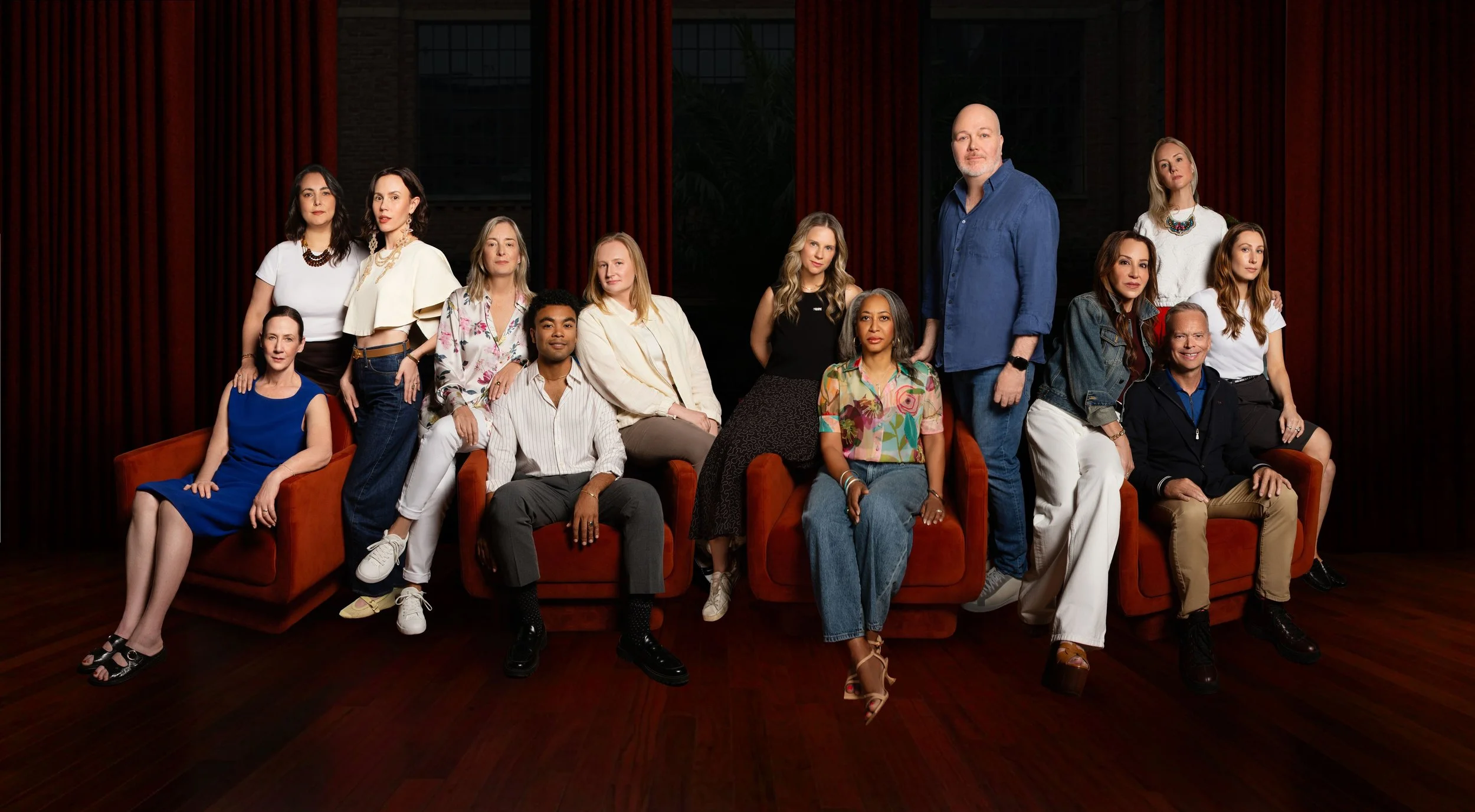
Industry leaders and creators gather to mark the launch of Pink Triangle Press's Pride in Production workplace inclusion training initiative. Pictured, left to right: Jennifer McGuire (PTP), Alexandrine Torres de Figueiredo, Jessica Lea Fleming, Julie Bristow, Alexander Nunez, Paige Haight, Katie Lafferty, Joy Loewen, Stuart Coxe, Kate Alexander Daniels, Allison Brough, David Walberg (PTP), and Katy Harding.
Ninety-three percent of Canadian screen industry professionals say 2SLGBTQIA+ representation matters. Only 41 percent believe their workplaces are actually inclusive for 2SLGBTQIA+ colleagues. That gap is the whole story.
Those numbers come from Pink Triangle Press's 2024 Pink Paper, one of the most comprehensive national studies of 2SLGBTQIA+ representation and workplace conditions across Canada's film, television, streaming, and gaming sectors. First presented at the Banff World Media Festival in June 2024, the research found broad agreement on why representation matters, and a much harder truth underneath it: saying the right things and building safe workplaces are not the same thing. Trans respondents reported feeling the least safe of any group surveyed.
Pink Triangle Press responded by building something practical. Pride in Production, supported by the Canada Media Fund, is a national training initiative designed to close that gap. Available free to screen industry organizations across Canada, the program consists of six 30-minute modules covering foundational inclusion language, intersectionality, workplace advocacy, leadership, and respectful workplace practices. The English-language curriculum is live now, with a French-language version set to launch in July 2026.
The training was developed with AlexiMK Consulting and is hosted by actors Kathleen Munroe and Mariah Inger. It wasn't built in isolation either. An influential group of industry leaders, including executives from the Canada Media Fund, Shaftesbury, Antica Productions, Catalyst, Blink49, and the Canadian Media Producers Association, helped inform the sector-specific approach.
“Working with industry partners, with their strong commitment, and with the support of the Canada Media Fund, we are pleased to share new tools to support closing the gap and ensuring that 2SLGBTQIA+ professionals feel supported, respected and safe in their day-to-day work," said David Walberg, CEO of Pink Triangle Press.
The Canada Media Fund framed its support around something beyond fairness. “When people feel comfortable being themselves at work, it leads to more creativity, and stronger stories," said Mathieu Chantelois, Executive Vice President of Communications, Strategy and Public Affairs at the Canada Media Fund. “This toolkit is a useful resource to help make that happen."
The screen sector is often where these conversations start. The research infrastructure, the union structures, the public funding mandates, all of it creates conditions where this kind of study and response can happen. But the findings aren't unique to a film set or a writers' room. Any industry where creative work depends on psychological safety, where the quality of the output is tied to whether people feel free to show up fully, is looking at the same gap. For Canadian marketers and brand professionals, Pride in Production is less a screen industry story and more a proof of concept: that research-backed, sector-specific inclusion training can be built, funded, and deployed at scale. The playbook exists. The question is who picks it up next.
The initiative launched during Pride Month, a deliberate choice. But the problem it addresses isn't seasonal. Workplaces don't become more inclusive once a year.
Organizations interested in the curriculum can visit pinktrianglepress.com/pride-in-production.
