
AI Errors Are Reaching the Public More Often Than Marketers Realize
Artificial intelligence is now embedded in everyday marketing workflows. It drafts blog posts, summarizes research, builds schema, generates reports, and supports strategy.
The value is clear. AI helps teams move faster.
But new research suggests that speed is coming with a measurable trade-off.
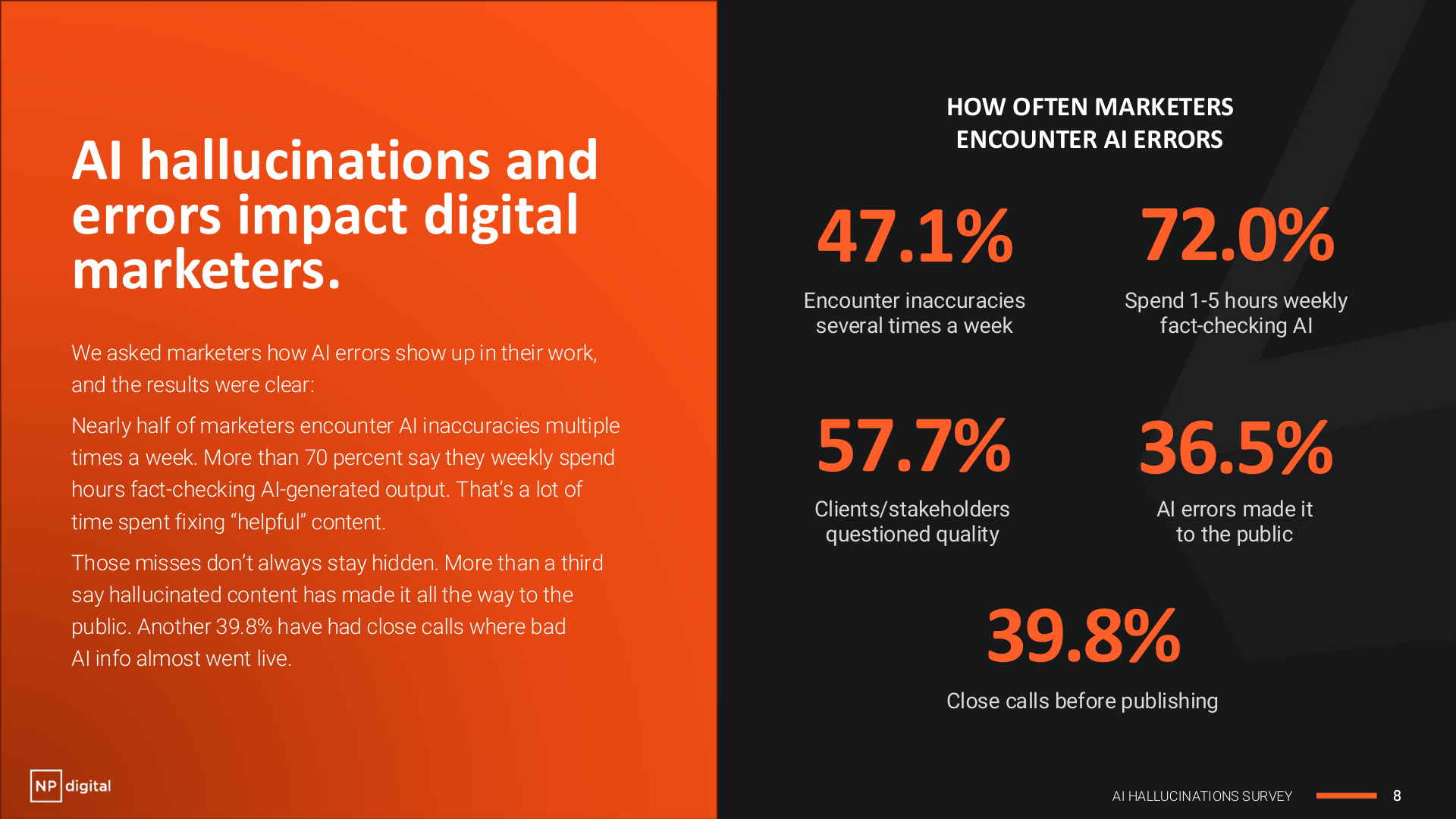
According to NP Digital’s newly released AI Hallucinations and Accuracy Report, 47.1% of marketers encounter AI errors several times per week, and 36.5% say inaccurate or hallucinated AI-generated content has gone live publicly.
The findings are based on two data sets: a 600-prompt accuracy test across six major large language models and a survey of 565 U.S.-based digital marketers.
The takeaway is straightforward. AI is accelerating production, but it is also introducing risk.
Page 8 of NP Digital’s AI Hallucinations and Accuracy Report
The Hidden Time Cost of AI
AI tools are positioned as efficiency engines. In many cases, they are.
At the same time, more than 70% of marketers report spending one to five hours per week fact-checking AI-generated output.
That is not light editing. It is recurring operational overhead.
As adoption expands across Canadian agencies and in-house teams, the conversation is shifting. The question is no longer whether AI can produce content. The question is what review structure surrounds it.
Only 23% of marketers say they feel comfortable using AI output without human review. More than half report that clients or stakeholders have questioned the quality of AI-assisted work.
AI is increasing velocity. It is also increasing the importance of verification.
When AI Mistakes Go Public
One of the most concerning findings in the report is how often errors reach audiences.
More than one-third of marketers say incorrect AI-generated content has been published publicly. The most common causes include false facts, broken or fabricated citations, and brand-unsafe language.
For agencies and brand teams, this is not simply a workflow issue. It is a trust issue.
Ronnie Malewski, Managing Director at NP Digital Canada, puts it plainly:
“As AI becomes more deeply embedded in marketing workflows, accuracy can’t be treated as an afterthought. When errors and hallucinations go unchecked, they can quickly reach clients or the public, eroding trust and damaging brand credibility and performance.”
The implication is not that AI should be avoided. It is that AI must be governed.
Which AI Tools Performed Best?
As part of the study, NP Digital tested 600 prompts across ChatGPT, Claude, Gemini, Perplexity, Grok, and Copilot.
ChatGPT delivered the highest rate of fully correct responses at 59.7 percent. Claude followed closely and recorded the lowest overall error rate.
However, no model consistently avoided mistakes. Errors were more common when prompts required multiple steps, addressed niche subject matter, or referenced recently updated information.
In fast-moving areas such as SEO, AI regulation, fintech, or SaaS, that limitation matters. Outdated or fabricated information can slip into content quickly if teams are not actively verifying outputs.
Selecting the right tool helps. Oversight matters more.
Where AI Struggles Most
The report found that AI errors are most common in tasks requiring structure or precision, including:
HTML or schema creation
Full content development
Reporting and analytics
Creative ideation and brainstorming produced fewer daily errors by comparison.
The pattern is consistent. AI performs best when supporting thinking. It is less reliable when precision and up-to-date accuracy are critical.
That distinction should influence how marketing leaders allocate AI across their teams.
AI Governance Is Becoming a Marketing Discipline
The research signals something larger than model performance.
Teams are adapting. Many have introduced additional approval layers. Some have assigned clearer ownership for final review. Others are developing internal AI usage guidelines.
Despite this, 23 percent of marketers still report feeling comfortable publishing AI output without human review.
This tension reflects a broader transition. AI is no longer experimental. It is operational. Yet it is not fully trusted.
For Canadian marketing leaders, this creates a strategic decision point. Competitive advantage will not come from using AI alone. It will come from building systems that protect accuracy while maintaining speed.
Stronger prompts help. Clear accountability helps more.
AI can support growth. Human oversight protects credibility.
